
Beyond The Grind
Psalm 127:1-2

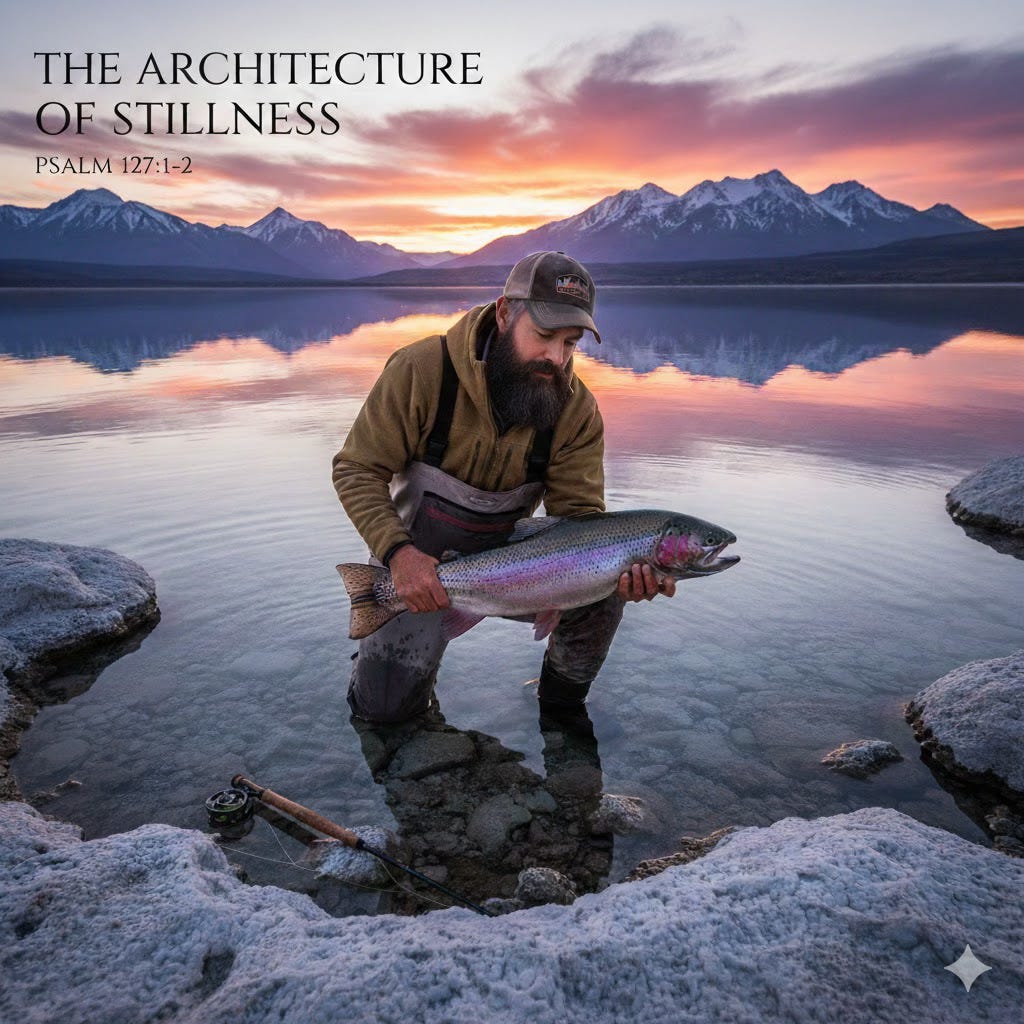
The wind in Patagonia doesn’t just blow; it commands your attention. For Frank, a man who had built multiple housing communities through eighty-hour workweeks and a relentless “grind” mentality, the towering peaks of the Andes felt like the first obstacle he couldn’t out-negotiate in years.
Frank traveled to the edge of the world to visit the legendary Lago Strobel, nicknamed Jurassic Lake, in search of giant rainbows. He brought the most expensive Orvis graphite rods, reels with surgical-grade drag systems, and a lifetime’s worth of experience in “getting things done despite the hurdles.”
For three days, Frank was a fishing machine. He got up before the sun, ignoring the stiffness in his back. He cast until his shoulder burned from fighting the relentless Patagonian wind gusts that turned his fly line into a tangled mess of “bird nests.”
He was anxious about his lack of success. Losing was not a word in his vocabulary. He checked his satellite phone for market updates during lunch. He stayed out past dusk, eyes straining against the dimming light, driven by a frantic need to justify the trip with a trophy fish. But the water refused to cooperate and relinquish a prize trout. The harder Frank worked, the more the fish seemed to hide. He was eating the “bread of anxious toil,” and it tasted terrible. Frank was beginning to believe all the hype about Patagonia was just that - hype.
On the fourth morning, the wind shifted from a roar to a whisper. Frank woke up, but instead of rushing for his waders, he sat on the lodge’s porch. He looked at the massive, snow-capped Andes mountains in the distance while sipping a cup of mate. The bitter local drink was an acquired taste. Frank was trying hard to acquire it, but he appreciated the caffeine buzz in the morning.
Frank reflected on his lack of trout over the first three days. He realized he had been trying to “build” his success on this water the same way he built his houses—through sheer, exhausted willpower.
He remembered the words of Psalm 127: “Unless the Lord builds the house, those who build it labor in vain. Unless the Lord watches over the city, the watchman stays awake in vain.”
This morning, Frank decided to leave the satellite phone on the nightstand. He walked to the river, not with the intent to conquer it, but to participate in it. He stopped seeing the fish as a paycheck for hard work and started seeing the river as a gift he couldn’t earn.
That afternoon, Frank didn’t fish. Instead, he sat on a tufa formation along the shoreline. The white rocks look almost alien. For the first time in ten years, he didn’t feel the “need” to be productive. He put down his rod, closed his eyes, and drifted into a deep, dreamless sleep, eased by the sound of the water and warmth of the sun.
He woke up two hours later, feeling refreshed. The sun was setting, and Frank marveled at how it cast the clouds in shades of bruised purple and fiery orange. He stood up, grabbed his rod, and made a smooth, relaxed cast, letting the fly sit.
There was no frantic stripping of the line, no jaw-clenching determination. Just a gentle take.
The trout was massive—a shimmering, silver-and-crimson bow of muscle. As Frank cradled the fish in the shallows before releasing it, he felt a peace that his bank account had never given him. Frank had worked less, yet he had received more. He finally understood: the best things aren’t built by our hands alone; they are granted to those who know how to rest in the One who holds the river.
Your writing brings us into the scene, and though I have done very little fishing and never been to Patagonia, I felt like a was able to be there and feel the colors, smells, warm sunshine and the refreshment of looking at things I have to do today differently, without hurry!
Nice Ed. It’s a stirring reminder that "smelling the roses" isn't a passive act; it is the active, rewarding choice to finally let the river—and life—simply be enough.