
The Clean Drift
Phillipians 4:8

The Midwest experiences severe rain for a few days, driven by storms fueled by warm, humid air surging north from the Gulf of Mexico. This moisture travels via the Subtropical Jet Stream. When this warm air hits the cold, dry air still lingering from Canada, it creates the “lift” and instability needed for severe thunderstorms and tornadoes. The system then hits the Polar Jet Stream, builds, and races toward the Ohio River Valley, dropping its burden of water. These rains make the water choppy and stained, while runoff creates debris that floats down rivers and streams, making fishing a challenge.
But it’s not just the water that deals with detritus. Frank struggles too. His mind is cluttered with the “silt” of life—worries about rising costs and inflation, raising teenagers, and the general “noise” of the news. He’s looking at the Brookville Tailwater and seeing only the translucent, dark amber water that looks like a strong pour of Pekoe tea, along with the “rock snot” (filamentous algae) and leaf litter that swirl in the water column. He’s casting, but his heart isn’t in it because he’s focused on what’s wrong with the conditions.
In a moment of self-reflection, Frank stops. He remembers a mentor telling him once, “You can’t catch a fish if you’re only looking at the trash on the surface.” He takes a moment to pray. Not with a request to “clear the water,” but an acknowledgment of the beauty that exists under the chaos.
Before Frank begins his next cast, he decides to practice a “mental drift” to calm his troubled mind and gain focus. He starts naming things he can see:
Whatever is true: The river is still flowing; the cycle hasn’t broken.
Whatever is noble: The way the gray heron stands perfectly and patiently still.
Whatever is pure: The cold pocket behind the boulder that’s likely holding a brown trout.
Instead of focusing on what is wrong with the water, Frank concentrates on seeing what is right with it. He sees a patch of sunlight hitting an easy-to-reach riffle, seemingly turning foam bubbles into glistening diamonds. He sees the fluid motion of a rainbow trout drifting sideways a few inches to intercept a nymph and then sliding effortlessly back into the cushion of the calm water behind the rock.
Frank slowly begins to realize that if he dwells on the “praise-worthy” elements of the day—the weight of the rod in his hand, the smell of the damp woods—his mind will stop being plagued by anxiety. For that moment, life can be made simple.
Frank makes another cast, and this time the fly lands true and softly at the top of a promising riffle. A flash of silver breaks the surface. It’s not a trophy fish, but it’s a vibrant, healthy trout.
Frank realizes that by focusing on “whatever is admirable,” he doesn’t just find a fish; he finds his inner peace. The “Father” doesn’t change the river’s color or the chaos on the surface; He changes Frank’s eyes. By listening to that small voice, Frank finds it much easier to hear than when his mind was focused on the poor stream conditions.
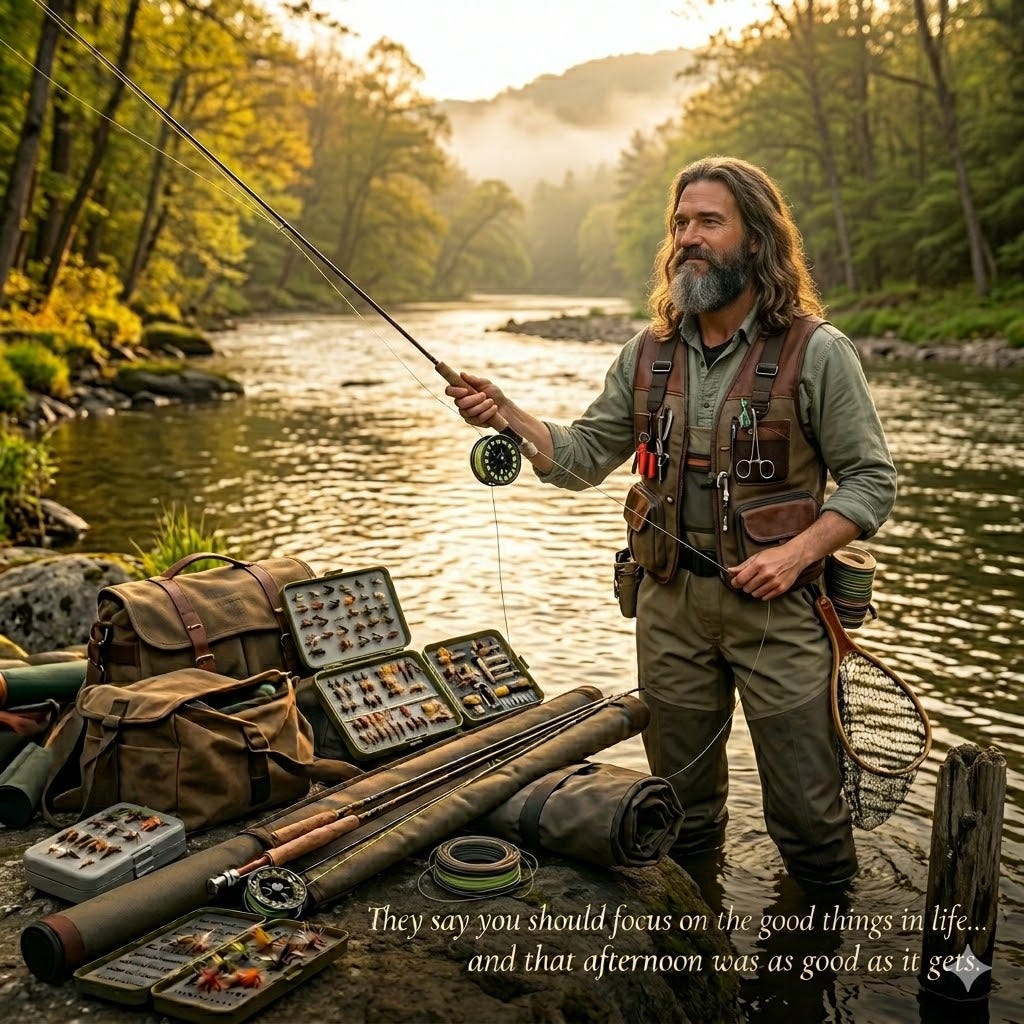
Frank spends a few more hours wading the Brookville Tailwater. As the sun starts to set, Frank focuses less on the trout he caught and more on the better things he gains: gratitude, clarity, and a quiet heart. Frank, packing up his gear, looks back at the dark water and says aloud, “They say you should focus on the good things in life... and that afternoon was as good as it gets.”
With a calmer mind, Frank heads home to face the challenges in his life with a renewed sense of looking beneath the chaos to see the real beauty.
Makes me want to be more observant and more grateful for what is good in my life!