
The Guide’s Path
Luke 11:1-2, Matthew 6:33

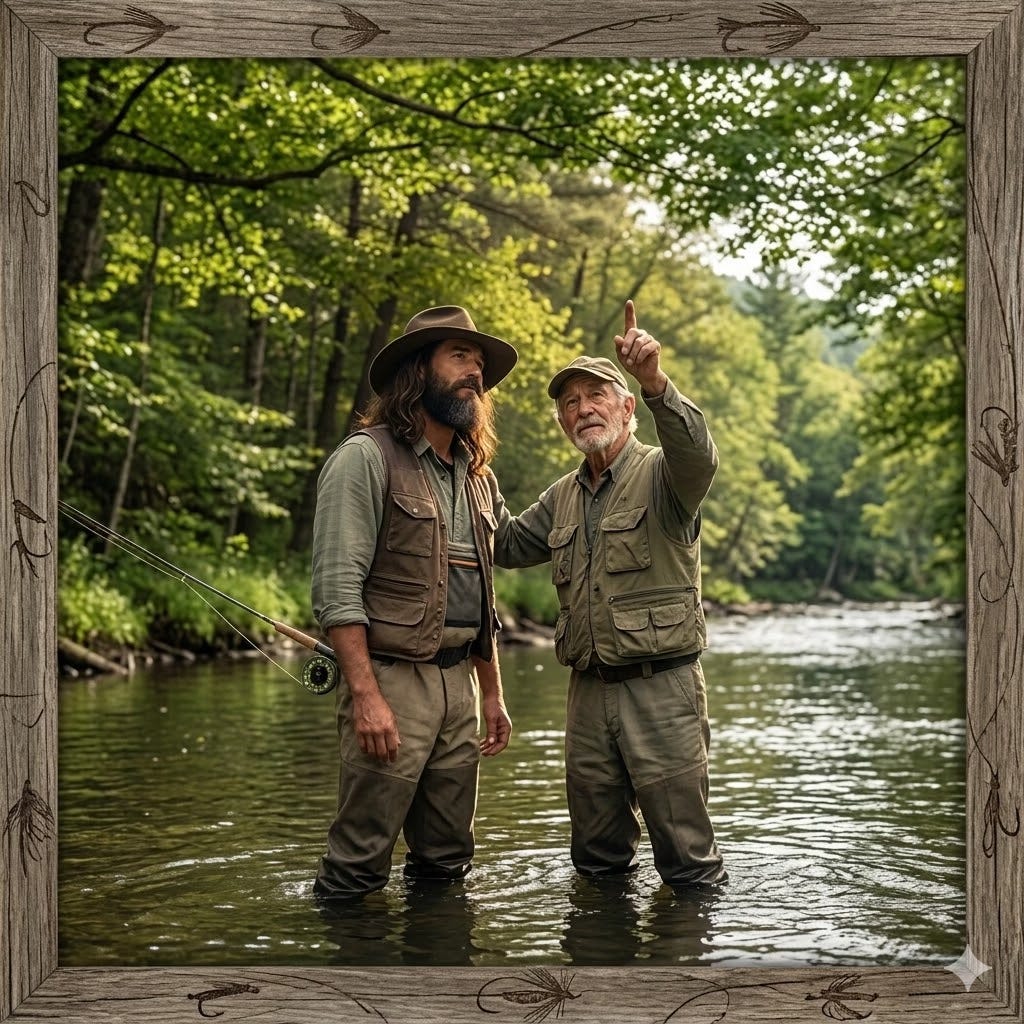
Frank had been whipping the water on the Battenkill River for a solid hour without any success. His shoulder ached from the constant casting, but his ego was hurt even more. The sun was climbing higher as morning turned into early afternoon. It’s mid-May, and between 10:00 AM and noon, the marquee hatch is a mayfly called the Hendrixson. Many fly fishermen consider it more than just a bug; for them, it’s a spiritual experience. It’s the first hatch of the season, and it attracts big, cautious, wild brown trout that look up at the surface.
The Hendrixson is about the size of a thumbtack, with mottled, smoky-grey wings that stand up like tiny sails. They dislike bright, hot sun and prefer those classic, “fishy” overcast mornings. They emerge from the rocky bottom and don’t just fly away instantly; instead, they have to “ride the river” for thirty or forty feet, fluttering their wings to dry them. To a trout, this appears as a slow-moving, defenseless steak dinner.
At the height of the hatch, thousands of them gather. The air is filled with what resembles heavy, grey snowflakes drifting upward. For about forty-five minutes, the river is covered in these “sailboats.”
Today is a perfect day for experiencing the hatch. But Frank’s poor start has shaken his confidence. A few pools upstream, an old-timer was working a difficult stretch with a quiet, effortless efficiency. Every loop of his line seemed to follow an invisible map of the water’s true heart, mending and drifting in perfect harmony that left the surface unbroken and the fish undisturbed.
The old-timer saw Frank staring and waved him over. Frank reeled in his line and started wading. When he reached the man, Frank said, “I’ve been at this for years, but I clearly don’t know the water as you do. Can you tell me how you seem to talk to the river?” Frank thought he might get a tip or two on casting, but the elder angler told Frank to stop and look up. He explained that before you ever cast a line, you have to start by respecting the Source. “Remember,” he said, “You aren’t the owner of the stream; you are simply a guest. You must acknowledge that God made the fish, the currents, and the hatch. It starts with humility and honoring the One who owns the water.”
Frank thought about the meaning behind the words and then asked for tips on catching a trophy native brown trout. The old-timer said, “It’s not about making the fish do what you want,” he says. “It’s about matching the hatch.” You have to align your timing with the river’s, you have to surrender yourself to the natural flow of the Lord’s plan. Focus on the cast right in front of you,” he says. “The river provides what is needed for this drift, this moment.”
Frank said, “I hear you, but I’d really like to land a trophy trout today.” The old-timer responded, “That’s your first snag. You want your will to be done on the water. But a real fisherman wants the River’s will to be done. If the river says ‘not today,’ you thank it anyway. If the river says ‘the hatch is small,’ you change your fly to match. You don’t tell the water what to do; you ask the water to show you where to be.”
“So I just wait and hope?” Frank asked. The old-timer grinned, his eyes sparkling with a kind of understanding that Frank was struggling to grasp. “No,” he said, “You listen. You ask for just enough light to see the next drift. Most guys worry about the fish they missed yesterday or the trophy they want tomorrow. Lay that burden down and just ask for the ‘daily hatch.’ Seek to understand what you need right now to stay in the flow.”
It was 9:45 AM, and the old-timer began preparing for the Hendrixson hatch. He was swapping out his #14 Red Quill for a #18 Parachute Adams. Frank sensed it was time to head downstream to find a pool of his own for the big event. As Frank turned to leave, the old-timer offered one last piece of advice - “Always remember, you have to acknowledge who’s in charge here. Look at the way the light hits the riffles. You’re standing in a cathedral, not a bathtub. Start by being glad you’re allowed in the water.”
Frank pondered the guidance he had heard. He let go of worries about what might or might not happen and began living in the moment. He could feel the sun warming the air, and he began to notice the smoky-grey wings emerging on the surface. Frank then heard the rhythmic “slurp-pop” sound of a trout’s snout breaking through the water. He saw a snout breach the surface—not a splashy, frantic jump, but a confident, deliberate rise. A large Battenkill Brown Trout had chosen a spot behind a rock and was just staying there, lifting its nose every few seconds to suck a Hendrickson down as if it were picking grapes off a vine.
The trout wasn’t worried about tomorrow’s meal. It was just accepting what the river was giving right now. Frank realized that’s how he should be standing in this water: matching the hatch and aligning himself with what’s actually happening.
Frank cast a Hendrixson dry fly a few feet above the start of the riffle and watched it drift slowly along a line leading to the rocks. Maybe the trout would pick his offering out from the hundreds of emerging flies floating downstream, hoping to take flight. Or maybe it wouldn’t. But, either way, Frank was ready to accept whatever the river gave him and would be grateful for the chance to be in that perfect spot on such a beautiful day, doing what he loved. He felt truly blessed.
To a trout, this appears as a slow-moving, defenseless steak dinner.
Love this word picture! 👏🏻👏🏻👏🏻